Table of Contents
ToggleIntroduction
This article explains how 𝕏’s new “Phoenix” timeline ranking algorithm works, based on the partially open-sourced architecture released in January 2026.
The prior algorithm, Heavy Ranker (2023), has been upgraded to Phoenix (2026).
Big shift: Phoenix (LLM-based) replaces manual development of the ranking algorithm
While Heavy Ranker was developed manually by Engineers who defined hundreds of features and tweaked weights to guess what you wanted, Phoenix is powered entirely by the same transformer architecture as xAI’s Grok (LLM) model, based on prior (and predicted) users’ actions.
Since January 20, 2026, the open-source code has been available on GitHub, and it’s refreshed every 4 weeks.
This publication puts an end to all guessing and speculation about why specific tweets show up in someone’s timeline and why others don’t.
So, let’s dive in and analyze how publishers ánd marketers can maximise their reach, engagement, and (marketing) exposure on 𝕏.
Or as a 𝕏-user, how to optimize your behavior to really get all the posts in your timelines you want to see and engage with.
We have open-sourced our new 𝕏 algorithm, powered by the same transformer architecture as xAI's Grok model.
— Engineering (@XEng) January 20, 2026
Check it out here: https://t.co/3WKwZkdgmB https://t.co/nQ5GH1a42e
The 𝕏 Algorithm: How the timeline is built
The For You feed algorithm retrieves, ranks, and filters posts from two sources:
- In-Network (Thunder) – Posts from accounts you follow.
- Out-of-Network (Phoenix Retrieval) – AI-discovered content from the broader platform.
Both sources are combined and ranked together using Phoenix that predicts engagement probabilities for each post. The final score is a weighted combination of these predicted engagements.
The Algorithm has eliminated every single hand-engineered feature and most heuristics from the system. The Grok-based transformer does all the heavy lifting by understanding your engagement history (what you liked, replied to, shared, etc.) and using that to determine what content is relevant to you. Your interests in real-time. It doesn’t follow rigid rules; it learns patterns.
Ranking logic
Instead of a single score, the model predicts multiple actions (~19) and combines them into a more nuanced ranking.
Positive actions (likes, reposts, shares) have positive weights. Negative actions (block, mute, report) have negative weights, pushing down content the user would likely dislike.
The algorithm uses your last 128 posts you’ve engaged with and, based on different engagement activities (with different weights), makes predictions for each Candidate post. The higher the predicted likelihood, the higher the ranking.
The system is modular, transparent, and stable, with each post scored independently, so results are cacheable and consistent. Meaning, everything you engage with recently will determine your feed.
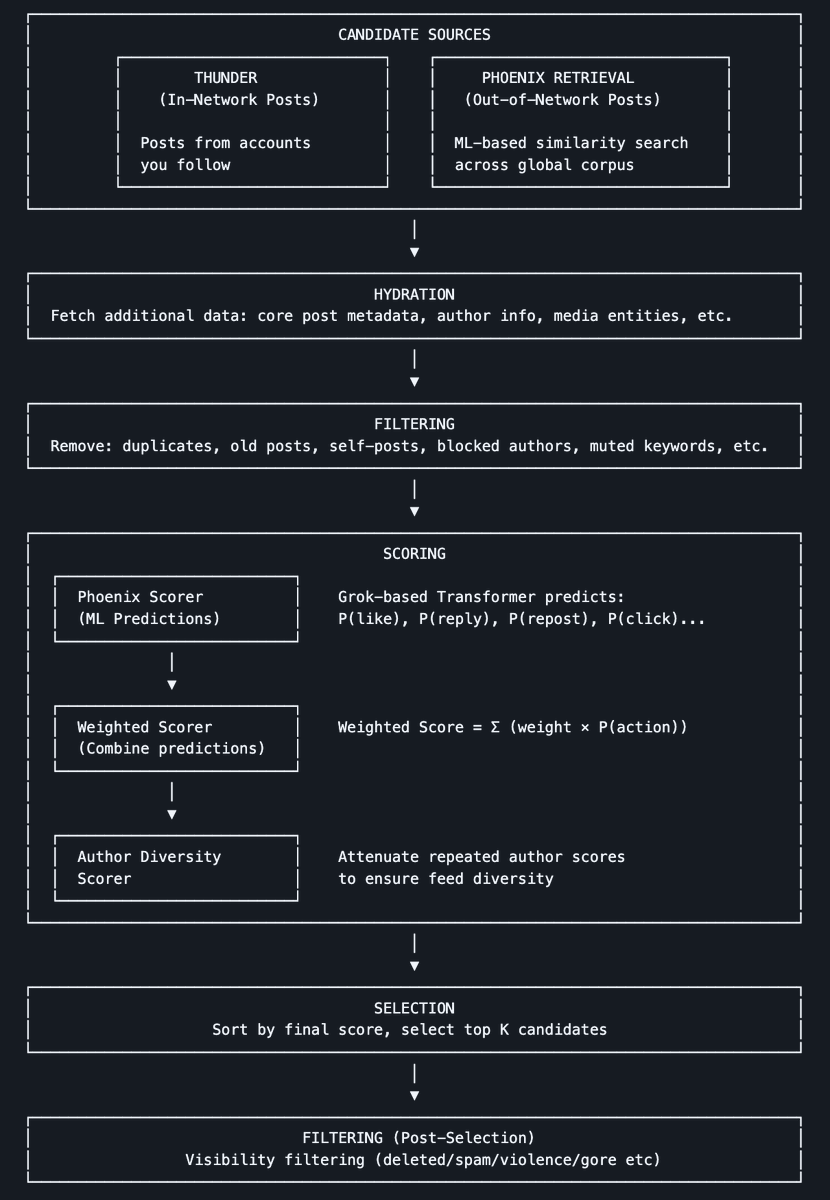
The 𝕏 Algorithm Architecture: How it Works
The Pipeline Stages
-
Query Hydration: Fetch the user’s recent engagement history and metadata (eg. following list)
-
Candidate Sourcing: Retrieve post candidates from:
- Thunder: Recent posts from followed accounts (in-network)
- Phoenix Retrieval: ML-discovered posts from the global corpus (out-of-network)
- Candidate Hydration: Enrich post candidates with:
- Core post data (text, media, etc.)
- Author information (username, verification status)
- Video duration (for video posts)
- Subscription status
- Pre-Scoring Filters: Remove posts for these purposes:
Filter Purpose DropDuplicatesFilterRemove duplicate post IDs CoreDataHydrationFilterRemove posts that failed to hydrate core metadata AgeFilterRemove posts older than threshold SelfpostFilterRemove user’s own posts RepostDeduplicationFilterDedupe reposts of same content IneligibleSubscriptionFilterRemove paywalled content user can’t access PreviouslySeenPostsFilterRemove posts user has already seen PreviouslyServedPostsFilterRemove posts already served in session MutedKeywordFilterRemove posts with user’s muted keywords AuthorSocialgraphFilterRemove posts from blocked/muted authors -
Scoring: Apply multiple scorers sequentially:
- Phoenix Scorer: Get ML predictions from the Phoenix transformer model
- Weighted Scorer: Combine predictions into a final relevance score
- Author Diversity Scorer: Attenuate repeated author scores for diversity
- OON Scorer: Adjust scores for out-of-network content
- Selection: Sort by score and select the top K candidates
-
Post-Selection Processing: Final validation of post candidates to be served
Filter Purpose VFFilterRemove posts that are deleted/spam/violence/gore etc. DedupConversationFilterDeduplicate multiple branches of the same conversation thread
The 𝕏 Algorithm Phoenix Scorers explained
The Phoenix Grok-based transformer model predicts probabilities for multiple engagement types:
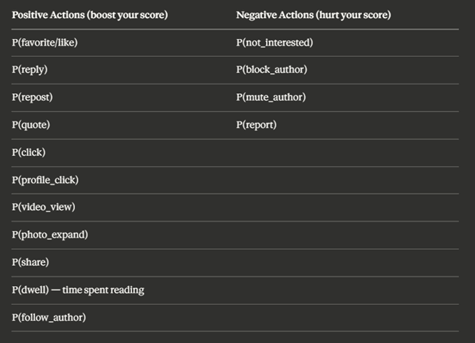
The Weighted Scorer combines these into a final score:
Final Score = Σ (weight_i × P(action_i)) + NEGATIVE_SCORES_OFFSET
Basically, the positive engagements on your post minus the negative engagements.
Note 1: If you analyse the code, you’ll notice that there are actually 19 different scorers. (As there are 3 different Share types, and 2 measurements for Dwell (score and time).
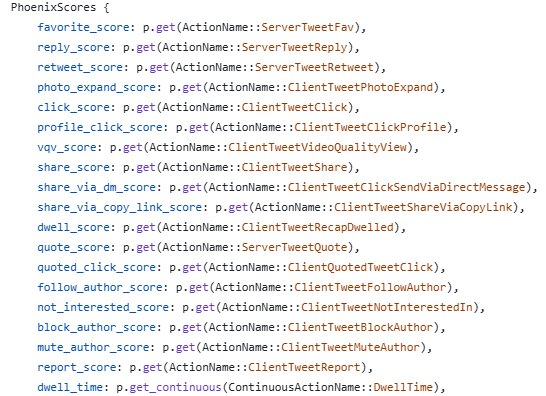
Note 2: For retweets, Phoenix looks up predictions using the original tweet ID.
Note 3: In addition to the vqv_score (Video Quality View), there is an additional weight (vqv_weight_eligibility) that assigns additional positive points if the video length exceeds a specific minimum duration. The consensus is that this current minimum duration is 2 minutes.
So, although the exact Model Weights and Parameters are hidden, there is a common belief that not all engagement scorers are treated equally. Some are more important (have a higher weight) than others.
I found these Relative Weights (source: https://x.com/CryptoKaleo/status/2013499298013393374)
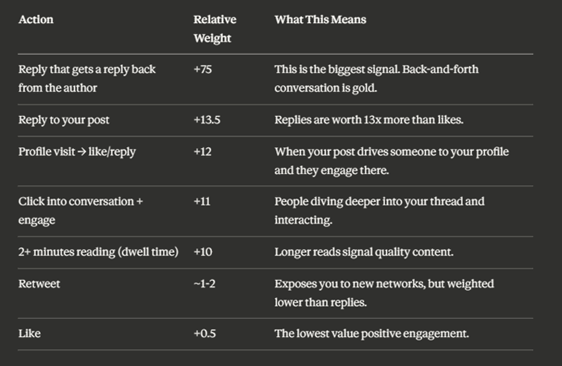
After the Phoenix scoring, there are two other modifiers:
- Author Diversity Scorer: Attenuate repeated author scores for diversity. This means that after your first post appears in someone’s feed, each additional post gets a progressively lower score. You can’t dominate anyone’s timeline. The diversity penalty is applied AFTER the ML scoring—meaning even if all your posts would score highly, they get knocked down just for being from the same author.
- Out-of-network (OON) Scorer: This scorer prioritizes in-network candidates over out-of-network candidates.
Limitations of the open source release
This open-sourced architecture describes the main modules. However, “for security reasons”, 3 modules are still hidden: the Clients, Params, and Util mods.
So, this public release is essentially a framework without the engine:
- Missing Weighting Parameters – The code confirms that “positive behaviors add points” and “negative behaviors deduct points”, but the exact numerical values are stripped out.
- Hidden Model Weights – The internal parameters and calculations of the model are not included.
- Undisclosed Client and Training Data – There is zero visibility into what data trained the model and how user behavior is sampled.
Source: https://x.com/BlockFlow_News/status/2013510113873813781
The core principle of the algorithm
Each 𝕏-user gets a unique, personalised timeline Feed that shows different Posts (and Ads) based on their recent engagement history, metadata, and xAI’s Grok LLM model.
Your feed is heavily personalised with these characteristics:
- Based on your behaviour, interests, interactions, and relationships.
- The system learns patterns dynamically rather than following static rules.
- Users effectively “train” their own feed through engagement.
So, the Poster has no direct influence on whether his post is shown in someone’s timeline.
Only indirectly, as per the algorithm, the chance increases if…
- The User is a Follower of the Poster.
- The User (recently) engaged with the Poster (either in public or in private chats).
- The User (recently) engaged with others about similar Post topics.
Hence, it’s the user who sits in the driver’s seat; his prior (engagement) actions with all potential post Candidates control the ranking of his timeline(s).
Note that the algorithm produces the results for a single Session and uses an Age Filter (only recent posts are shown). In the next Session, the results will be different. leaving often out earlier already seen posts. (Tip: bookmark or save Posts you like and don’t want to “lose”)
The 𝕏-platform is a commercial platform that encourages usage as often and for as long as possible (to maximise ad revenue). The primary way to do this is to show content that users prefer. Hence, by “learning and collecting personal data” and “improving the user experiences” to give users what they like and want.
As a user, be careful about how you engage. Your feed is literally what you train it to be. If you keep interacting with drama, bait, or low-quality takes, that’s what your X-Timeline experiences become for you. The algorithm is just mirroring your own behaviour.
The good part is that you can actively “train” the algorithm on what you want to show up in your timeline(s). For the posts you like, respond with “positive” engagement actions as per the Phoenix scorer. And for the posts you don’t want to see in the future, clean up your feed by responding with “negative” actions.
Beyond the Feed ranking mechanism
Users can enter/visit the 𝕏-platform in many ways.
Some will visit their home timeline regularly, while others may only enter the platform via redirects (shares, website embeds, other social media platforms, email recommendations, etc.).
There are also many other 𝕏 features besides the “home” timelines. Think about “Explore”, “Today’s News”, “What’s happening (Trending)”, “Who to Follow”, “Relevant People”, “Notifications”, “Mentions”, “Chat”, “Grok”, “Lists”, “Communities”, “Creator Studio”, “Subscriptions”, 𝕏 Spaces, and “Premium” features. And what else am I missing?
So, it’s the user who decides when, how, and which 𝕏 features to use for their personal interest and “benefits”.
And it’s the same for marketers. They have to choose which features to use to connect and engage with their target audiences.
Below, I will focus on how to take advantage of this new ranking algorithm from a business point of view (including creators and influencers) and especially for marketing managers who want to increase and optimize their 𝕏-marketing via regular posting (not via advertising).
But be aware that posting (and engaging) on 𝕏 should be part of the overall social media (content) marketing strategy and (free and paid) campaigns. Hence, not just restricted to 𝕏 alone, but it should be considered as an integral part of all other social media and marketing “communications”.
Best Practices for 𝕏 marketing
Key insight: Content that sparks conversation and engagement dramatically outperforms content that just gets scrolled by and/or only gets passive likes.
Knowing the underlying Phoenix scorers and likely weights is essential for maximum reach and exposure.
Below are some general principles and tips based on this new 𝕏-algorithm.
Do’s (What works now)
- Maximize Positive Engagements and focus on the ones with the highest relative weight. The algorithm prioritizes conversation over broadcast – A post that generates a back-and-forth conversation is valued significantly higher than a post that simply gets viewed (and/or liked). Hence, reply to feedback. Ask questions, share opinions people want to react to, or make statements that invite discussion.
- Hold Viewer Attention. Maximize Dwell time. If someone clicks your tweet/thread and stays for >2 minutes, you win. If they click and bounce in 3 seconds, you get penalized.
Use long(er) text posts where viewers have to click or scroll to see all the content. Use line breaks to make content scannable. Grab viewers attentention and hook them into the content. Use Videos, Threads, 𝕏 Spaces (Live Podcasts), and publish Articles for longer dwell time. - Use Rich Media (Especially Video). Posts with images get roughly 2x the impressions of text-only posts. Native video (uploaded directly to 𝕏, not linked) gets 2-4x more reach. Add captions to videos.
- Keep users on the 𝕏-platform. Avoid external links to other platforms or websites. Although the algorithm removed this “default” penalty and made it dynamic based on domain reputation, there are still penalties. For example…Substack/YouTube? Heavy penalty. News sites? Medium penalty. Links to X.com itself? Neutral.
- Content consistency. Stay in your SimCluster (Niche). This filter calculates your “Vector Distance” from your niche. If you are a “Crypto Account” and you tweet about “Politics,” your distance score spikes. High distance = The algorithm assumes your followers don’t care.
- Quality (professional) content above (low) Quantity content.
- Jumping on Trends is no problem, but only if added value to the conversation.
- Profile Authority is important. Not only for the “Business” account, but also for the main founders and team members’ individual accounts. (Tip: don’t stick with solely business posts, but let team members post to diversify the reach and engagement, and become more personal)
- Upgrade your 𝕏-account to at least the Premium level (for verification mark, boost exposure, write Articles, and get better view stats).
Do nots (works no longer)
- Do not flood the feed. Space out your Posts to avoid the Author Diversity Scorer penalty.
- Don’t post spam or low-quality content. Don’t try to trick the system via post-engagement farming. Grok is actually reading all your posts and making adjustments (penalizing) for low quality. You can’t fool a keyword filter anymore. You must write something that the LLM AI respects.
- Cross-posting identical content from other social media platforms. This is seen as self-promotion and will be downranked.
- Buy” (fake) Followers by rewarding them for following you (attracts the wrong group of “freebee seekers” only interested in rewards instead of the product/services).
- Rewarding Likes and Post-engagement farming.
- Pay for InfoFi or “bot” accounts that automatically engage (like, share, repost).
- Include irrelevant keywords, hashtags, and mentions.
- Stop reposting (or clipping) of externally (YouTube or TikTok) videos. Be a creator with new native videos posted exclusively on 𝕏.
- Avoid Negative Feedback (blocks, muted, reports, not interested).
- Avoid Controversial Content. Steer clear of safety filters.
Where to start?
A simple, practical tip to start is to categorize (and group) your recent posts based on total impressions per post.
For example, use 5 categories (Very Poor, Poor, Adequate, Good, Excellent) and try to find what makes the differences by looking at:
- Type and length (Standard, Long-Form (Article), Threads).
- Form (Text, Image, Video, Live Video, Poll, etc.)
- Content Categories (Educational/Informational, Entertaining/Memes, Personal/Status Updates, Promotional, Branding).
- Usages of Keywords, Mentions, and Hashtags.
- Engagement (Replies/Quotes/Reposts/DM).
Learn from your mistakes and bad performers, and focus on the elements that work for your audience. Set impressions and engagement targets. And make it a habit to analyze your performance and raise the bar.
Smart additional tips using AI
Take what you learn above and ask Grok to analyse your 𝕏-profile.
Whatever Grok says, ask it to make a 30-day plan to optimize your profile with a growth plan to increase exposure.
Boom! You will have a 30-day game plan.
If you want a more detailed look, then I’d highly suggest having your AI agent thoroughly review the 𝕏-algorithm and ask any questions about different parts of it.
Use 𝕏 strategically
Originally, 𝕏 is unique for its real-time, public-forum nature, focusing on immediate news, trends, and, often, unfiltered/raw conversation, setting it apart from more curated platforms like Instagram or LinkedIn.
The platform excels at showing “what’s happening now” through live hashtags, trends, and topical threads.
Since its new ownership, 𝕏 has expanded to include long(er)-form posts, AI and personalization, and a pivot toward becoming an “everything app”, all to stimulate users to use the platform as often as possible (to increase ad and subscription revenues).
This new For You Feed 𝕏-algorithm is just one clear sign of this evolving functionality.
Another sign is that starting January 2026, 𝕏 Premium Members can now post Articles, while before this was only a Premium+ privilege.
So, marketers should adapt and take advantage of this new direction.
Resources
Must follow 𝕏 Accounts:
X Engineering: https://x.com/XEng
xAI: https://x.com/xai
Nikita Bier, Head of Product 𝕏: https://x.com/nikitabier